繁体中文
繁体中文-
 English
 -
 שפה עברית
 - 繁体中文
-
 Latviešu
 -
 беларускі
 -
 Hrvatski
 -
 lugha ya Kiswahili
 -
 አማርኛ
አማርኛ -
 ქართული
 -
 Hausa
Hausa -
 Zulu
Zulu -
 Հայերեն
 -
 Igbo
Igbo -
 Yoruba
 -
 Español
 -
 Português
 -
 русский
 -
 Français
 -
 日本語
日本語 -
 Deutsch
 -
 tiếng Việt
 -
 Italiano
 -
 Nederlands
 -
 ภาษาไทย
 -
 Polski
 -
 Svenska
 -
 magyar
 -
 Malay
Malay -
 Dansk
Dansk -
 Suomi
Suomi -
 हिन्दी
 -
 Pilipino
 -
 Türkçe
 -
 العربية
 -
 Indonesia
 -
 Norsk
Norsk -
 český
český -
 ελληνικά
 -
 український
 -
 فارسی
فارسی -
 български
 -
 Қазақша
 -
 Azərbaycan
 -
 Slovenský jazyk
 -
 Lietuvos
 -
 Eesti Keel
 -
 Română
 -
 Slovenski
 -
 Srpski језик
 -
 한국어
한국어

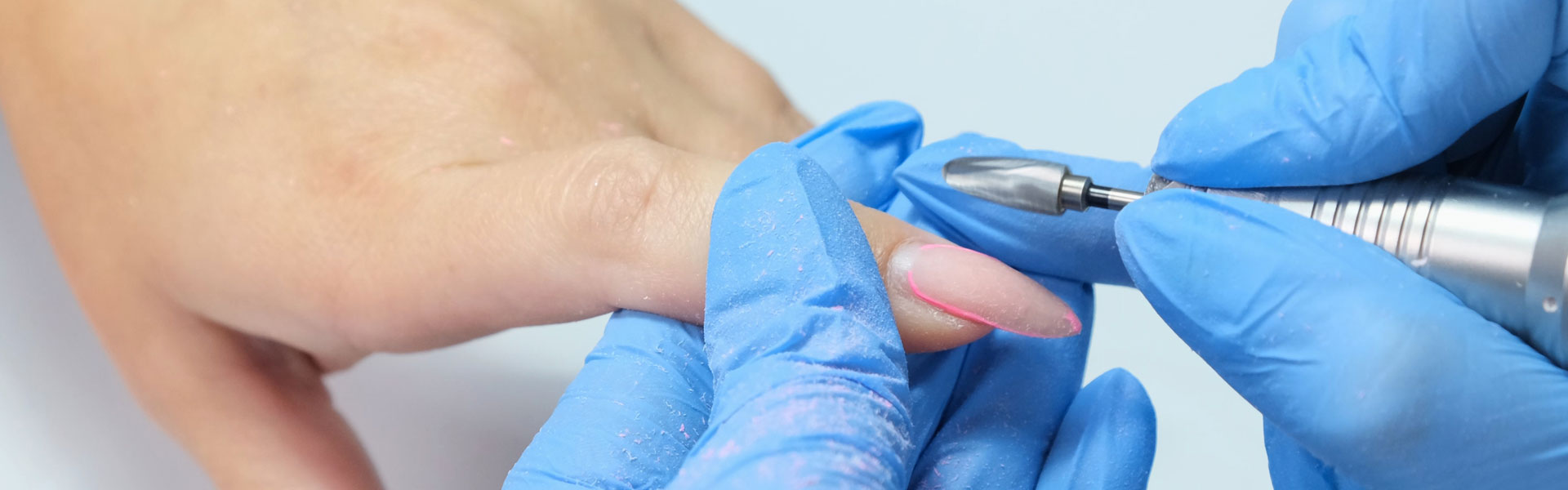
是什麼讓雙波長指甲乾燥燈與所有凝膠品牌相容?
In the professional nail care industry, one question persists among technicians and salon owners: "Will this lamp work with my gel brand?" The frustration of investing in a premium gel polish line, only to find that it under-cures or over-heats in a specific lamp, has been a persistent challenge. The root of this incompatibility lies not in the quality of the gel or the lamp individually, but in the mismatch between the lamp's emission spectrum and the photoinitiators used in the gel formulation. Photoinitiators, the chemical compounds that trigger the polymerization (curing) process, are activated by specific wavelengths of light. A lamp that does not emit the correct wavelengths will fail to cure the gel properly, leading to tacky surfaces, poor adhesion, or premature chipping.
雙波長的出現指甲烘乾燈 technology has effectively resolved this compatibility challenge. By incorporating two distinct wavelength bands—typically 365nm (UVA) and 405nm (visible violet)—these lamps can activate the full spectrum of photoinitiators used in modern gel polish formulations. This dual-wavelength approach ensures that regardless of whether a gel brand relies primarily on UVA-sensitive or visible-light-sensitive photoinitiators, the Nail Dryer Lamp will deliver the energy required for complete polymerization. This article provides a comprehensive technical analysis of dual-wavelength Nail Dryer Lamps, examining the photochemistry of gel curing, the advantages of wavelength diversity, the technical specifications that define performance, and the practical considerations for salon professionals seeking universal compatibility.
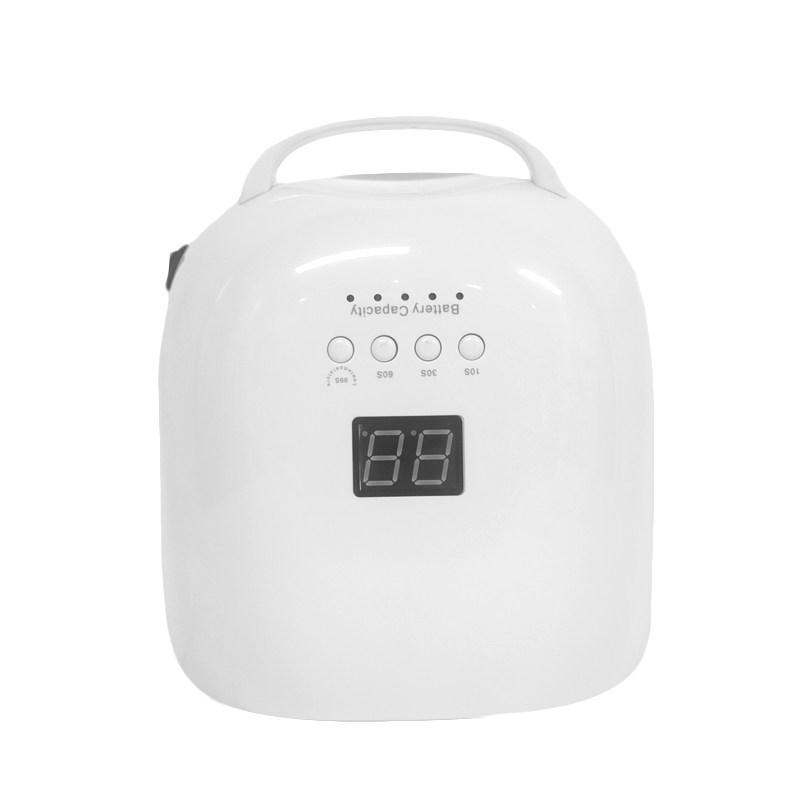
目錄
- 1. 凝膠固化的光化學:為什麼波長很重要
- 2. 雙波長技術如何實現通用相容
- 3.雙波長指甲烘乾燈的關鍵技術指標是什麼?
- 4. 波長覆蓋範圍如何影響固化時間和凝膠性能?
- 5. 波長之外還有哪些因素影響相容性和固化品質?
- 6. 常見問題(FAQ)
- 七、結論
1. 凝膠固化的光化學:為什麼波長很重要
To appreciate the value of dual-wavelength Nail Dryer Lamps, it is essential to first understand the photochemistry of gel curing. Gel polishes are formulated with a mixture of monomers, oligomers, and photoinitiators. The photoinitiators are the "trigger" compounds that initiate the polymerization reaction when exposed to light of a specific wavelength. Different photoinitiators have different absorption spectra, meaning they are activated by different wavelengths of light. The two primary families of photoinitiators used in gel polishes are Type I and Type II photoinitiators, each with distinct wavelength sensitivities.
Type I photoinitiators are cleaved by light absorption, creating two free radicals that initiate polymerization. They are typically sensitive to shorter wavelengths in the UVA spectrum, around 365nm. This is the traditional wavelength used in early UV nail lamps. Type II photoinitiators, on the other hand, require a co-initiator (often an amine) and are typically sensitive to longer wavelengths, such as 405nm in the visible violet spectrum. The absorption spectrum of a gel polish determines which wavelength or wavelengths will effectively cure it. A gel formulated primarily with a 365nm-sensitive photoinitiator will cure well in a lamp that emits strongly at 365nm. However, it may not cure fully in a lamp that only emits at 405nm, and vice versa.
The problem for nail professionals is that there is no universal standard for photoinitiator selection among gel brands. Some brands favor UVA-sensitive systems, while others have transitioned to visible-light-sensitive systems, often to reduce the potential for skin exposure to UVA radiation. As a result, a salon may use gel brands that require different wavelengths for optimal curing. A single-wavelength Nail Dryer Lamp can only cure those gels that are compatible with that specific wavelength. This is the core of the compatibility problem. The introduction of dual-wavelength technology directly addresses this by providing both wavelengths, ensuring coverage for the vast majority of photoinitiator systems on the market.
下表提供了凝膠拋光劑中使用的主要光引發劑類型及其波長敏感性的比較:
| 光引髮劑類型 | 範例化合物 | 主波長靈敏度 | 典型的凝膠配方類型 |
| I 型(UVA 敏感) | TPO、BAPO | 365nm - 380nm | 傳統的紫外線固化凝膠 |
| II 型(可見光敏感) | 樟腦醌 + 胺 | 405nm - 470nm | LED 固化凝膠、「低熱」凝膠 |
| 混合/混合系統 | TPO+樟腦醌 | 365奈米和405奈米 | 雙固化通用凝膠 |
在深圳市瑞納光電有限公司,我們設計了具有精確雙波長輸出的指甲乾燥燈產品,以確保與盡可能廣泛的凝膠配方相容。我們工廠對光學工程和品質控制的承諾確保每盞燈都能提供一致且有效的固化光譜。
2. 雙波長技術如何實現通用相容
The core innovation of the dual-wavelength Nail Dryer Lamp is its ability to emit two distinct, optimized wavelength bands simultaneously. This is typically achieved by incorporating two different types of LED chips within the lamp array: one emitting at 365nm (UVA) and one emitting at 405nm (visible violet). The LEDs are arranged to provide uniform illumination across the entire curing area, ensuring that the gel is exposed to both wavelengths throughout the curing cycle. The dual-wavelength approach is not simply about adding more light; it is about providing the specific spectral energy needed to activate the full range of photoinitiators.
When a gel containing both a 365nm-sensitive and a 405nm-sensitive photoinitiator is exposed to a dual-wavelength Nail Dryer Lamp, both photoinitiator types are activated simultaneously. The 365nm light triggers the UVA-sensitive photoinitiator, while the 405nm light triggers the visible-light-sensitive photoinitiator. This dual activation ensures that the polymerization reaction proceeds efficiently, regardless of the gel's specific formulation. The result is a complete cure with excellent adhesion, gloss, and durability. This is in contrast to a single-wavelength lamp, which may leave a gel partially uncured if it relies on a photoinitiator that is not activated by the lamp's wavelength.
Furthermore, the dual-wavelength approach can also reduce the total curing time. Because both photoinitiator systems are activated simultaneously, the polymerization reaction occurs more rapidly, reducing the curing time required. This is a significant advantage in a busy salon environment, where time efficiency is a key business driver. It is important to note, however, that the power output at each wavelength is also critical. A lamp must deliver sufficient intensity at both wavelengths to achieve a complete cure. Our Nail Dryer Lamp products are designed with high-output LED chips, ensuring that the required intensity is achieved at both wavelengths.
下圖提供了單波長燈、雙波長燈的光譜比較以及兩種常見光引髮劑的吸收光譜。
| 燈頭類型 | 發射光譜 | 活化光引髮劑類型 | 凝膠相容性 |
| 單波長(365nm) | UVA 峰值窄 | 僅 I 型(UVA 敏感) | 僅限 UVA 固化凝膠 |
| 單波長(405nm) | 狹窄的可見紫色峰 | 僅 II 型(可見光敏感) | 僅限於 LED 固化凝膠 |
| 雙波長(365nm + 405nm) | 兩個不同的峰 | I 型和 II 型 | 通用相容性 |
The dual-wavelength Nail Dryer Lamp has therefore become the standard for professional salons that work with multiple gel brands. It provides a "one-size-fits-all" solution that simplifies the curing process and ensures consistent, high-quality results. At Shenzhen Ruina Optoelectronic Co.,Ltd, we have conducted extensive compatibility testing with leading gel brands to confirm the effectiveness of our dual-wavelength Nail Dryer Lamp products. The test results demonstrate that our lamps deliver full curing with no tackiness or heat spikes across a wide range of gel formulations.
3.雙波長指甲烘乾燈的關鍵技術指標是什麼?
Selecting a dual-wavelength Nail Dryer Lamp requires a careful evaluation of the technical specifications that define its performance. These specifications cover the optical, electrical, and thermal characteristics of the lamp. Understanding these parameters is essential for making an informed purchasing decision. The following are the key technical specifications to consider:
波長輸出: The wavelength output is the primary specification. A dual-wavelength lamp must emit at both 365nm (UVA) and 405nm (visible violet). The wavelength tolerance is typically +/- 5nm. Some lamps may also include other wavelengths to target specific applications, but the 365nm and 405nm combination is the most critical for universal compatibility.
功率輸出/輻照度: The power output, measured in milliwatts per square centimeter (mW/cm²), determines the intensity of the light. Higher irradiance results in faster curing times. For gel curing, an irradiance of 50-80 mW/cm² at each wavelength is considered sufficient for most applications. Some lamps offer higher power outputs for faster curing, but this can also increase the heat generated during curing.
LED 數量和陣列設計: The number and arrangement of LEDs determine the uniformity of the illumination. A large number of LEDs, arranged in a uniform array, ensures that the entire nail surface receives an even dose of light. Uneven illumination can result in patchy curing, where some areas are fully cured while others remain tacky.
固化定時器:燈應該有一個可編程定時器,具有針對不同凝膠類型(基底、顏色、面漆)的多個預設時間。典型的計時器設定包括 30 秒、60 秒和 90 秒。
下表總結了高性能雙波長指甲乾燥燈的主要規格:
| 規格 | 典型值 | 筆記 |
| 波長1 | 365奈米+/-5奈米 | UVA 波段,活化 I 型光引髮劑 |
| 波長2 | 405奈米+/-5奈米 | 可見紫光帶,活化 II 型光引髮劑 |
| 輻照度(365nm) | 50-70 毫瓦/平方厘米 | 在固化表面測量 |
| 輻照度(405nm) | 50-70 毫瓦/平方厘米 | 在固化表面測量 |
| LED 數量 | 42-60 個 LED | 更高的計數確保均勻的覆蓋範圍 |
| 定時器設定 | 30後、60後、90後 | 可程式設計 |
| 電源輸入 | 12V直流/24W | 低功耗 |
| 工作溫度 | 25°C - 40°C | 不應超過 45°C |
在Shenzhen Ruina Optoelectronic Co.,Ltd, our Nail Dryer Lamp products are designed to meet or exceed these specifications. We use high-quality LED chips from leading manufacturers to ensure consistent output and long life. Our lamps are also equipped with a built-in temperature management system to prevent overheating, ensuring a comfortable curing experience for clients.
4. 波長覆蓋範圍如何影響固化時間和凝膠性能?
The curing time of a gel polish is determined by a combination of the gel's photoinitiator formulation, the lamp's wavelength coverage, and the lamp's irradiance. A dual-wavelength Nail Dryer Lamp provides a distinct advantage in this regard. By activating both the UVA-sensitive and the visible-light-sensitive photoinitiators, the curing reaction proceeds more rapidly and more completely. In a single-wavelength lamp, only one photoinitiator system is activated, which can result in a slower and less complete cure. The difference in curing time can be significant, with dual-wavelength lamps often reducing the curing time by 30-50% compared to single-wavelength lamps.
The impact of wavelength coverage on gel performance is also critical. A complete cure results in a gel that is hard, durable, and glossy. An under-cured gel will have a tacky surface, which may persist after the lamp cycle. The tackiness can cause issues with adhesion of subsequent layers (such as top coat) and can also attract dust and debris. Over-curing, while less common, can cause the gel to become brittle and prone to chipping. The dual-wavelength lamp, by providing the correct spectral energy for the gel's photoinitiator system, helps to achieve the optimal cure, balancing hardness with flexibility and ensuring long-lasting wear.
Furthermore, the dual-wavelength approach can also reduce heat generation during the curing process. When a gel is cured at a wavelength that does not match its photoinitiator absorption spectrum, the excess energy is often dissipated as heat. This can cause discomfort for the client, particularly during the curing of base coats and builder gels. By matching the wavelength to the photoinitiator absorption, the curing reaction is more efficient, and less energy is wasted as heat. This is another significant advantage of dual-wavelength technology, as it contributes to a more comfortable and pleasant salon experience.
下表提供了同一凝膠品牌的單波長和雙波長指甲乾燥燈的固化時間和凝膠性能的比較。
| 燈頭類型 | 固化時間(底漆) | 固化時間(顏色) | 固化時間(面漆) | 表面黏性 | 發熱 |
| 單波長(365nm) | 60年代 | 90年代 | 60年代 | 輕微黏性(某些凝膠) | 緩和 |
| 單波長(405nm) | 45秒 | 60年代 | 45秒 | 輕微黏性(其他凝膠) | 低的 |
| 雙波長(365nm + 405nm) | 30秒 | 45秒 | 30秒 | 無粘性(所有凝膠) | 低的 |
這些數據表明,雙波長指甲乾燥燈可為客戶提供更快的固化時間、改善的表面光潔度和更舒適的體驗。在深圳市瑞納光電有限公司,我們將這些性能優勢融入我們的指甲乾燥燈產品線中,確保我們的客戶可以使用任何凝膠品牌獲得專業品質的效果。
5. 波長之外還有哪些因素影響相容性和固化品質?
While wavelength coverage is the most critical factor for compatibility, it is not the only factor. The performance of a Nail Dryer Lamp is also influenced by the power output (irradiance), the uniformity of the illumination, the lamp's distance from the nail, and the temperature management of the lamp. Each of these factors must be considered to achieve optimal curing results.
輻照度(功率輸出): The irradiance of the lamp determines the speed and efficiency of the curing process. A lamp with insufficient irradiance will require a longer curing time or may not cure the gel completely, regardless of the wavelength. For professional use, an irradiance of at least 50 mW/cm² at each wavelength is recommended. Higher irradiance can reduce curing times, but it also increases the risk of heat generation. A well-designed Nail Dryer Lamp will balance irradiance with temperature management.
照明均勻度: The LED array must be designed to deliver a uniform dose of light across the entire nail surface. If the illumination is uneven, some areas of the nail may be over-cured while others are under-cured. This can lead to patchy adhesion, premature chipping, or a tacky surface. A good-quality Nail Dryer Lamp will have a large number of LEDs arranged in a symmetrical pattern to ensure uniform coverage. Some lamps also incorporate reflectors or diffusers to further improve uniformity.
距釘子的距離: The distance between the lamp and the nail affects the irradiance and the uniformity of the light. The lamp should be positioned at the manufacturer's recommended distance. If the lamp is too far away, the irradiance will be reduced. If it is too close, the light may be too intense, causing heat spikes and potential discomfort for the client.
溫度管理: The curing process generates heat, and the lamp itself also generates heat. Overheating can cause discomfort for the client and can also affect the performance of the gel. High-quality Nail Dryer Lamps incorporate temperature management systems, such as cooling fans or heat sinks, to maintain a comfortable temperature. Some lamps also have a "low-heat" mode, which reduces the power output to minimize heat generation when using sensitive gels.
在Shenzhen Ruina Optoelectronic Co.,Ltd, we have designed our Nail Dryer Lamp products with careful consideration of all these factors. Our lamps feature a high-density LED array, precision optics for uniform illumination, and a built-in cooling system to maintain optimal operating temperatures. This ensures that our customers can achieve consistent, professional-quality results with any gel brand.
6. 常見問題(FAQ)
問題1:雙波長指甲烘乾燈可以治癒市面上所有品牌的指甲油嗎?
Answer: A dual-wavelength Nail Dryer Lamp that emits at 365nm and 405nm with sufficient irradiance is compatible with the vast majority of gel brands. These two wavelengths activate the most common photoinitiators used in modern gel formulations. However, some specialized gels may contain photoinitiators that are sensitive to other wavelengths. In practice, dual-wavelength lamps cover more than 95% of all gel brands. At Shenzhen Ruina Optoelectronic Co.,Ltd, we have tested our Nail Dryer Lamp products with over 80 leading gel brands to confirm their compatibility.
問題 2:雙波長指甲烘乾燈對皮膚暴露安全嗎?
Answer: Dual-wavelength Nail Dryer Lamps emit UVA and visible light, which are generally considered safe for skin exposure in the short durations required for gel curing. However, it is important to follow the manufacturer's instructions and to avoid prolonged exposure. Many lamps are designed with automatic shut-off timers to prevent overexposure. The use of a sunscreen on the hands is also recommended to protect the skin from the effects of UVA exposure.
問題 3:雙波長和「多波長」或「全光譜」指甲烘乾燈有什麼不同?
Answer: A dual-wavelength Nail Dryer Lamp specifically emits at two optimized wavelengths: 365nm (UVA) and 405nm (visible violet). A multi-wavelength lamp may include additional wavelengths to target specific gels or to provide additional features such as curing of specialty gels. A "full-spectrum" lamp may include a wider range of wavelengths, but this is often not necessary for standard gel curing. The dual-wavelength approach is the most efficient and effective solution for universal compatibility.
問題4:雙波長指甲烘乾燈可以同時用於凝膠指甲和壓克力指甲嗎?
Answer: A dual-wavelength Nail Dryer Lamp is specifically designed for curing UV and LED-cured gel polishes. It cannot be used to dry acrylic nails, as acrylic nails are cured by a chemical reaction, not by light. The Nail Dryer Lamp will have no effect on acrylic nails. For acrylic nails, a separate drying system is required.
問題 5:我如何知道我的指甲烘乾燈是否完全固化了我的甲油膠?
Answer: A properly cured gel polish will have a hard, glossy, and non-tacky surface. If the gel feels sticky or tacky, it is under-cured. If the gel appears cloudy or has a hazy surface, it may have been over-cured. The best way to ensure complete curing is to use a Nail Dryer Lamp with the correct wavelength and sufficient irradiance, and to follow the manufacturer's recommended curing time for your specific gel brand. Our dual-wavelength Nail Dryer Lamp products are designed to provide a consistent and reliable cure for all gel types.
七、結論
The dual-wavelength Nail Dryer Lamp represents a significant advancement in nail care technology, providing a solution to the long-standing problem of gel brand compatibility. By emitting at both 365nm and 405nm, these lamps can activate the full range of photoinitiators used in modern gel formulations, ensuring complete polymerization with all gel types. The dual-wavelength approach also offers advantages in curing speed, heat management, and overall gel performance.
在Shenzhen Ruina Optoelectronic Co.,Ltd, we are committed to providing high-quality Nail Dryer Lamp products that meet the needs of professional nail technicians and salon owners. Our dual-wavelength lamps are engineered with precision optics, high-output LEDs, and advanced temperature management to deliver consistent, reliable performance. Whether you are a professional salon or a home user, our Nail Dryer Lamp products provide the compatibility and performance you need to achieve perfect gel nails every time.
立即聯絡深圳市瑞納光電有限公司了解有關我們的雙波長指甲乾燥燈產品以及它們如何增強您的美甲服務的更多資訊。